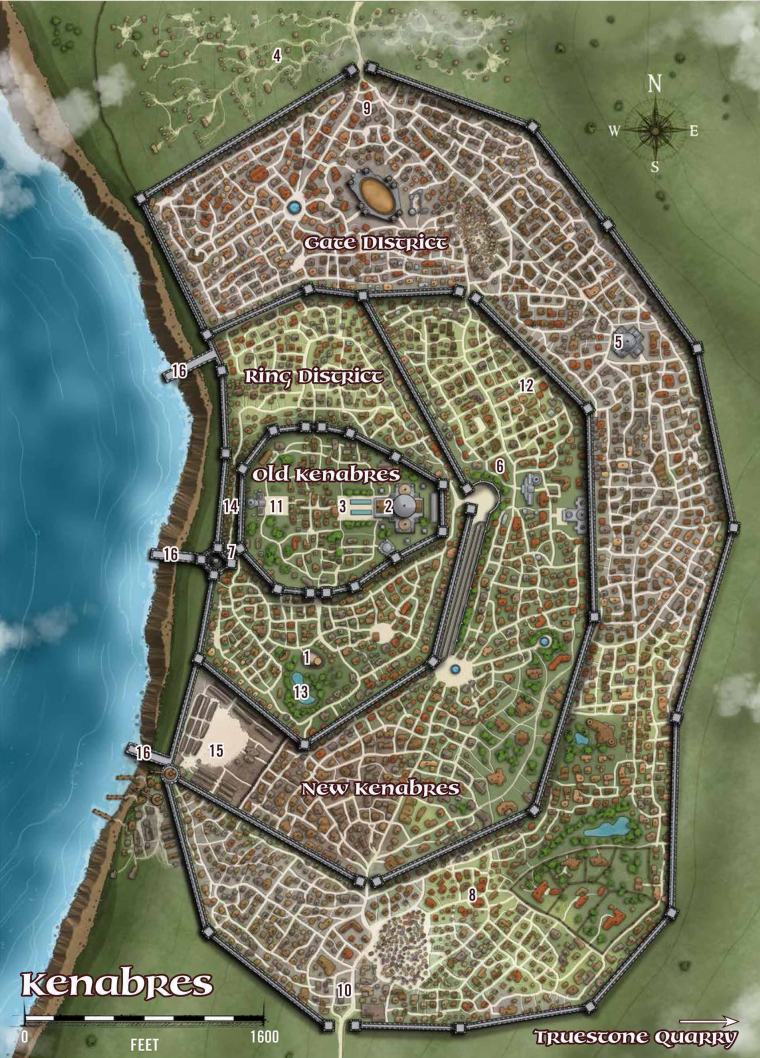
The city of Kenabres overlooks the Worldwound from its perch on the eastern bluffs above the West Sellen river. It’s the gathering place for crusaders headed into the Worldwound, and home to a resolute—if occasionally overzealous—group of defenders.
Before the Worldwound opened, spilling demonic hordes into doomed Sarkoris, Kenabres was a small and industrious town on the border. The people of old Kenabres traded up and down the river, and they drew their water from it via a cunning system of pumps and pipes. After the coming of the Worldwound, the town was overrun with refuges. The citizens of Kenabres at first took them in graciously. This initial hospitality was checked when a demonic infiltrator disguised as a refugee, slaughtered 62 citizens in early 4607 AR. Subsequent immigrants were subjected to close scrutiny and suspicion, and were forced to undergo continual invasive tests to prove their humanity.
Despite the growing difficulty of being accepted into Kenabres, refugees continued to pour in from Sarkoris. A century after the opening of the Worldwound, the town has grown into a small city. A series of walls were erected as Kenabres grew, creating several physically separate districts. Today, the more than 12,000 inhabitants live almost entirely within the fortifications, while gathering crusaders make camp outside the walls to the north of the city.
After the Second Crusade, the church of Iomedae built a stone keep to house Kenabres’s wardstone. One of a series set along the border with the Worldwound, the wardstone keeps demonic forces from crossing the line between it and its neighbors, as long as its attendant priests maintain its power with prayer and ritual. Between the wardstone and the fortifications, Kenabres has been a relatively secure stronghold against the demons—but it has been less secure from corrupting forces within the walls. Starting with misplaced zeal in the First Crusade, there has been a tradition of witch hunting in Kenabres. The "witches" that have been burned at the stake in the intervening years were mostly just people who were different in faith or just physical appearance. Operating ostensibly under the aegis of the church of Iomedae, the witch hunters have often been a law unto themselves, taking whatever measures they deem necessary to keep Kenabres free of demonic corruption and possession. The prevalence of the witch hunters has waned somewhat in the years since the Fourth Crusade, but they remain at the ready to respond to any demonic threats that may arise—whether real or imagined.
Characters that were raised in Kenabres have for all their lives known the preparation for war and the threat of attack. Even the youngest adventurers from the city have seen the town grow and change in their lifetimes, and have witnessed an ever-changing collection of crusaders passing through. Living in the shadow of a demonic threat is different than living in a normal war-torn land: the looming enemy can’t easily be understood or related to, nor can the demons’ motivations be analyzed and exploited. Growing up with such a threat always present is sure to color the worldview of a young adventurer.
Kenabres Districts
Old Kenabres: The original town ofKenabres perched on the edge ofthe cliff, looking down over the West Sellen. Many of those buildings now form the historic central district. The houses here are well constructed from heavy stone, with angled tile roofs and arched windows characteristic of architectural fashions popular hundreds of years ago. Houses and official administrative buildings-including the courthouse, city hall, and the garrison-make up Old Kenabres. The houses aren't the largest in the city and not always home to the wealthiest citizens, but the oldest families, who can trace their lineage back hundreds of years, live in Old Kenabres. Hulrun Shappok lives here in the Prelate's Manor.
Ring District: The second tier of the city, circling Old Kenabres, was also a part of the original town of Kenabres. More homes and administrative buildings, including the hall of records and the maintenance building for monitoring the water pumps, make up the Ring District. At the district's eastern edge, a steep switchback road makes the transition between the higher-elevation Ring District and the lower-elevation districts of New Kenabres and the Gate District. The switchback is called Davon's Ramp after the architect and philanthropist who designed and paid for the structure as the town grew to a city. Heavy iron gates safeguard the top and bottom of the switchback. For security, these gates are locked an hour after sunset, and a guard is posted at each. Persons wishing to use the switchback must make their case to the guards and hope their business is deemed important enough. Some citizens have special, expensive passes that allow them to move back and forth without question, and some say that the Wallers (see entry 14) have their own methods of moving beyond the Ring District after curfew.
New Kenabres: New Kenabres was built during the initial flood of refugees after the opening of the Worldwound. Buildings in this mostly residential district are stone, but the walls are thinner than in the older districts, and the houses are built in a more modern style, with flat roofs and square windows. New Kenabres also houses most of the city's warehouses. The eastern and southeastern sides of New Kenabres hold many of the largest manors in the city. During the construction of New Kenabres, many moneyed families chose to build new homes in the new district, as it offered just as much safety as the old city but without the claustrophobic density.
Gate District: A decade after New Kenabres rose, the Gate District followed. City officials realized that the new housing units wouldn't be enough to support the city's growth, and in response constructed the Gate District - the largest district in Kenabres. The Gate District includes a mix of residential and commercial buildings, as well as wealthy family homes. Temples to Abadar, Sarenrae, Shelyn, and Torag sit alongside smithies, stoneworks, and woodshops. The city's two gates, Northgate and Southgate, lead into this district.
Truestone Quarry: Truestone Quarry lies approximately 10 miles to the east. Caravans arrive weekly to supply Southgate with stone for constructing additional buildings and reinforcing the city defenses. Guards are always in high demand to protect these caravans from coordinated demon attacks, and to ensure the deliveries keep stone flowing into the city.